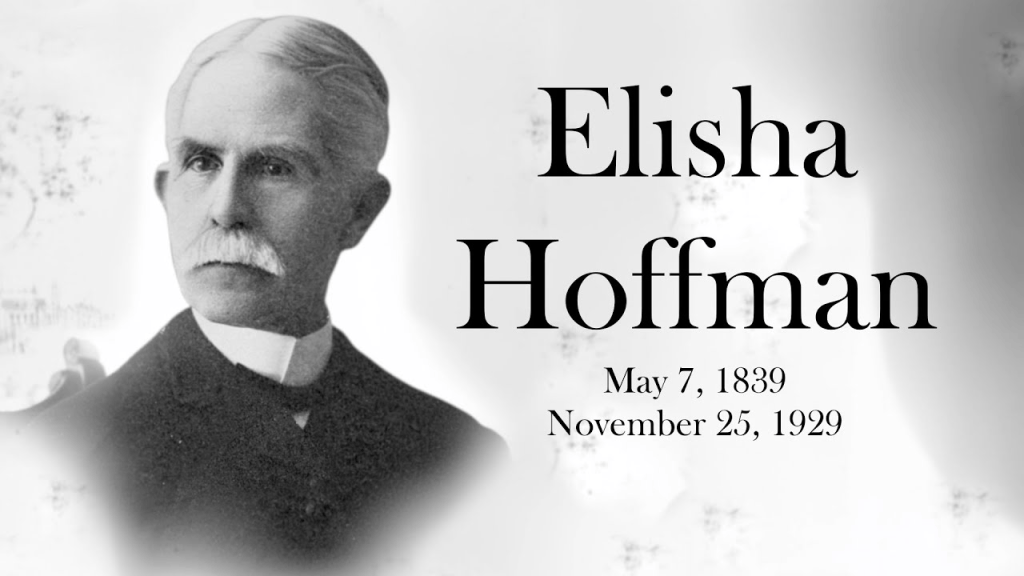
I woke up this morning singing the old hymn, ‘Leaning on the Everlasting Arms’. I don’t know where it came from in; I can’t have sung it for sixty years. I looked it up. It was written by Elisha Hoffman who was born in Orwigsburg, Pennsylvania in 1839.
What a fellowship, what a joy divine,
leaning on the everlasting arms;
what a blessedness, what a peace is mine,
leaning on the everlasting arms.
Leaning, leaning,
safe and secure from all alarms;
leaning, leaning,
leaning on the everlasting arms.
Wikipedia told me more about Elisha Hoffman:
His father was a minister… He was brought up going to church and singing hymns… During the American Civil War he enlisted in the Union Army… He attended a Seminary, in New Berlin, Pennsylvania… In 1866 Hoffman married Susan… He was ordained by the Presbyterian Churches in 1873… In 1876, his wife, Susan died, leaving him a single parent of their three sons… In 1879 He married Emma… From 1880 to his retirement in 1922 Hoffman ministered in churches in Ohio and Michigan… He wrote over 2,000 hymns, edited over 50 song books… He wrote ‘Leaning on the Everlasting Arms in 1894.
Hoffman defined a hymn as: ‘A lyric poem, reverently and devotionally conceived, which is designed to be sung and which expresses the worshipper’s attitude toward God or God’s purposes in human life. It should be simple and metrical in form, genuinely emotional, poetic and literary in style, spiritual in quality, and in its ideas so direct and so immediately apparent as to unify a congregation while singing it.’
I think ‘Leaning on the Everlasting Arms’ demonstrates this:
O how sweet to walk in this pilgrim way,
leaning on the everlasting arms;
O how bright the path grows from day to day,
leaning on the everlasting arms.
What have I to dread, what have I to fear,
leaning on the everlasting arms?
I have blessed peace with my Lord so near,
leaning on the everlasting arms.

I love the image. It comes from Moses’ final blessing on Israel. They’ve come out of slavery in Egypt, they’ve been in the desert for forty years, and they’re about to enter their Promised Land. Moses final recorded words include, ‘The eternal God is your refuge and underneath are the everlasting arms.’ It’s a wonderful picture of strength and protection in the present, and security and hope for the future.
In a world where I’m told I should be strong and independent, but often feel I’m weak and insignificant, The God of Moses, the God of Elisha Hoffman, is the God with everlasting arms that I can lean on and be supported by today.
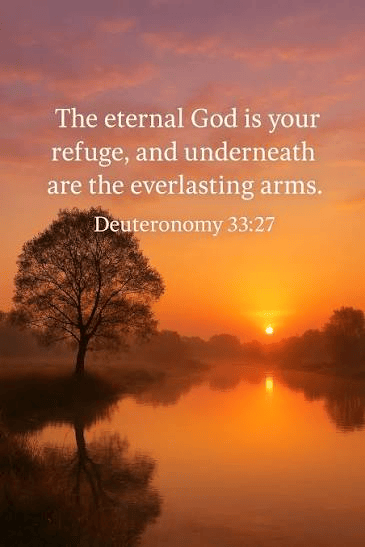


I love these words of Moses, from Deuteronomy. I’ve heard them before, but didn’t know the complete context. I’ve also sung, Leaning on the Everlasting Arms many times. Nancy and I often include it in the songs we sing at care homes.
LikeLiked by 2 people
It is a good old hymn, David, but I haven’t sung it or heard it for many, many years. It’s good to be re-introduced!
LikeLike
Thanks for sharing this encouraging assurance Malcolm. But for His everlasting arms around me I’d be everlasting lost.
Be blessed brother, and …
Keep Looking Up ^ … His Best is Yet to Come!
LikeLiked by 2 people
It really is a good picture, Fred, which describes the God who has kept us safe and protected us up till now, and will carry us to His best that is yet to come.
LikeLiked by 1 person
Jackson always does a great job with traditional hymns.
LikeLiked by 1 person
I found a variety of versions, Dana. I felt that some were too cheesy, and some lost the power of the words in the musical production. I felt Alan Jackson’s version has some authenticity and integrity (even if he does miss the middle verse!)
LikeLiked by 1 person