
This morning I read Jesus’ familiar story usually known as ‘The Prodigal Son’. A boy demands money from his parents and leaves home. He has a great time until his money runs out. Hungry and alone he decides to return home. His father welcomes him with joy and affection…
I paused at the point where he makes a decision, ‘I will do something… return to my father… apologise… try to put things right…’
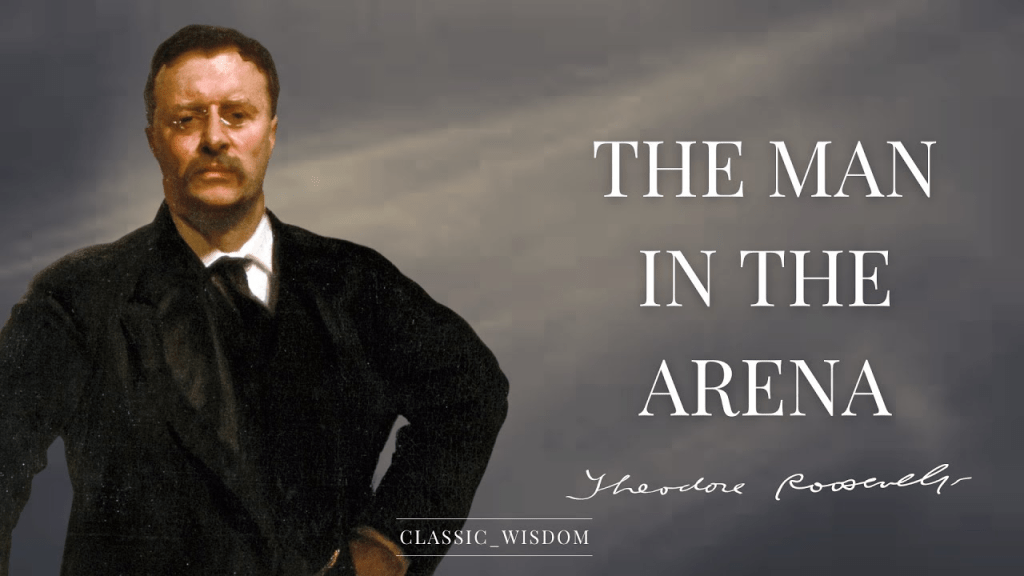
In 1910, at the Sorbonne in Paris, Theodore Roosevelt gave a famous speech that included these words:
‘It is not the critic who counts; not the man who points out how the strong man stumbles or where the doer of deeds could have done them better. The credit belongs to the man who is actually in the arena, whose face is marred by dust and sweat and blood; who strives valiantly; who errs, who comes short again and again, because there is no effort without error and shortcoming…’
I watch TV. ‘Commentators’ point out the failings of political leaders. ‘Pundits’ explain what footballers have done wrong or could do better. Roosevelt says that those who takes action deserve more credit than those who observe… Anyone could advise or criticise the Prodigal Son. He deserves credit for admitting that he’s messed up, and for taking positive action.

Yesterday’s local TV news included an interview with twelve-year-old Hephzibah. As an eight-year-old she felt there weren’t enough books with lead characters from minority backgrounds in her library. Her mum told her, ‘instead of complaining, I should make a change.’
She started writing… ‘I decided that the [lead] should be a black girl, just to show others that anyone can be the main character…’ Her first book was published when she was ten; her books are now in her library.
Today I shall meet friends and family. It’s easy to be passive – listening, being a critical friend, giving ‘good advice’. Sometimes I’m required to enter Roosevelt’s arena, write Hephzibah’s book, take the Prodigal’s positive, determined action.
 malcolmsmusings.org
Thank you, it doesn’t matter where you start but where you end matters. Amen
LikeLiked by 2 people
I agree – and to end well you have to take action and keep moving
LikeLiked by 1 person
Amen, Malcolm. It’s much easier to criticize than to take positive action. Life is indeed is not always fair. However, like the girl in your story, we can make it fairer.
LikeLiked by 2 people
We seem to live in a world when we are expected to notice faults, criticise and complain. I don’t think it helps or does us any good
LikeLiked by 1 person
Agreed.
LikeLiked by 1 person
This is wonderful. Whether in our own lives or generally, real change comes when we stop just observing and actually step into the arena ourselves. Thanks for sharing this, Malcolm!
–Scott
LikeLiked by 1 person
I love the Roosevelt speech – the arena paragraph is only a small part. It always challenges me, Scott.
LikeLiked by 1 person
You’ll get no argument from me, sir. It is a very good one!
–Scott
LikeLiked by 1 person
Powerful lesson, Malcolm!
LikeLiked by 1 person
And like many lessons, Wynne, if we truly learn it there must be practical consequences.
LikeLike
Your post brings to mind a quote, Malcolm: “Correction does much, but encouragement does more” (Johann Wolfgang von Goethe). Important to remember!
LikeLiked by 3 people
Thanks, Nancy. I haven’t met that quote before.
LikeLike
Thank you for your reflection, Malcolm. Your words resonate and inspire me to say aloud, “I will…” and take steps in a new direction. (I have struggled to find words to write, and yet I want to keep encouraging and comforting people for these challenging days.) Your reflections always bless me.
LikeLiked by 1 person
Thanks, Karen. For me inaction is often the easiest response – when often ‘I well’ is the response I should make.
LikeLiked by 1 person